Source Outdoor Welded Parcel Delivery Box with Flip Door for Apartments, Villas, and Offices
Find 30 outdoor welded parcel delivery box with flip door units from verified Chinese manufacturers. Buyers can compare specifications, customization options, and pricing for apartment, villa, and office building applications.
Key considerations
Products List




Comprehensive Sourcing Guide
Strategic Sourcing Guide for Outdoor Welded Parcel Delivery Boxes with Flip Door
Procuring outdoor welded parcel delivery boxes with flip doors requires a rigorous approach that balances structural integrity with operational flexibility. These units are designed to withstand environmental exposure while providing secure access for residential and commercial deliveries. The core of this procurement strategy lies in understanding the specific manufacturing attributes, such as the welded construction and flip door mechanisms, which differentiate these units from bolted or riveted alternatives. Buyers must navigate a market where customization is prevalent, with suppliers offering varied dimensions, finishes, and organizational structures to meet diverse site requirements. This guide outlines the critical factors for sourcing these units effectively, ensuring that the final selection aligns with both security needs and long-term durability expectations.
Technical Specifications and Structural Integrity
The fundamental characteristic of the target product is its welded structure, which provides superior rigidity compared to other assembly methods. This construction technique is essential for outdoor applications where wind loads, potential impact, and thermal expansion can compromise weaker joints. The material composition is predominantly metal, offering the necessary strength to deter tampering and resist corrosion. When evaluating technical specifications, buyers should verify the sheet metal thickness, as this directly correlates with the unit's resistance to forced entry and environmental wear. Standard specifications often cite regular thicknesses around 0.7mm, though this can vary based on the specific model and intended load-bearing requirements.
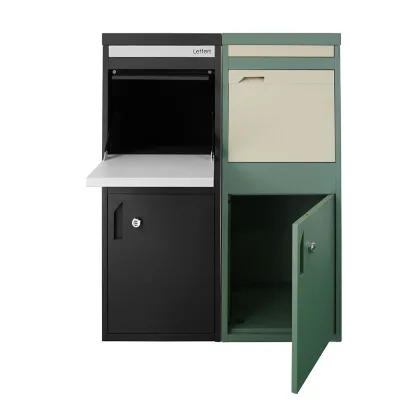
The physical dimensions of these boxes are frequently customizable to fit specific architectural constraints or volume needs. While some standard models may feature dimensions such as H850W410D430mm, the market generally supports "as your request" sizing to accommodate unique installation sites. The flip door feature is a critical functional element, designed to allow secure access for delivery personnel while maintaining a sealed environment for the contents. This mechanism must be robust, often integrated into a welded frame to prevent prying. Additionally, the installation method is a key differentiator; these units are available in floor-standing configurations or wall-mounted options, allowing for versatile deployment in apartment complexes, villas, and office buildings. The color options typically include standard industrial finishes like black, white, and grey, but customization is widely available to match building aesthetics.
Compliance, Certification, and Material Standards
In the realm of B2B procurement, verifying compliance and certification is non-negotiable, particularly for products installed in public or semi-public spaces. The manufacturing process for these welded boxes should adhere to recognized quality management systems. Suppliers often cite certifications such as ISO9001 for quality management and ISO14001 for environmental management. These standards indicate that the factory maintains consistent production processes and manages its environmental impact responsibly. However, buyers must treat these certifications as observations of the supplier's capabilities rather than automatic guarantees for every unit in a batch. It is imperative to request valid, up-to-date certificates before finalizing an order.
Material standards are equally critical. The metal used must be suitable for outdoor exposure, implying a need for protective coatings or galvanization to prevent rust. While specific alloy grades may not always be listed in general product descriptions, the presence of a "Customized" standard designation suggests that material specifications can be tailored to meet local environmental challenges. For instance, coastal locations may require higher-grade anti-corrosion treatments. Buyers should also verify the "Condition" of the product, ensuring it is supplied as "New" and not refurbished, as this impacts the warranty and lifespan. The packaging standards, such as "Full Assembly Package" or "Carton Box Outside with Foam Board Inside," are also indicators of the supplier's attention to detail during transit, ensuring the welded structure arrives without deformation.
Cost Drivers and Pricing Dynamics
Understanding the cost drivers for outdoor welded parcel delivery boxes is essential for budgeting and negotiation. The primary factors influencing price include the material thickness, the complexity of the welded structure, and the level of customization required. Units with a flip door mechanism and welded frames generally command a higher price point than simple bolted assemblies due to the increased labor and equipment required for fabrication. The observed price range in the market spans from approximately $10 to $1,800 USD, reflecting the vast difference between small, single-unit models and large, multi-compartment systems designed for high-volume postal services.
Minimum Order Quantity (MOQ) is another significant cost variable. The market typically sees MOQs ranging from 1 to 100 units, offering flexibility for small projects while encouraging bulk purchasing for large developments. Buyers should note that "Customized" attributes, such as specific dimensions, colors, or logo applications via silk print or laser marking, often incur additional costs. The trade terms, including FOB, EXW, CIF, and CNF, also play a crucial role in the final landed cost. For instance, an EXW (Ex Works) price from a supplier in Guangdon or Henan, China, will differ significantly from a CIF price that includes insurance and freight. Buyers must calculate the total cost of ownership, including shipping, duties, and installation labor, rather than focusing solely on the unit price.
Typical Applications and Usage Scenarios
The versatility of welded parcel delivery boxes with flip doors makes them suitable for a wide array of applications. The primary usage scenarios include apartments, villas, and office buildings, where secure package delivery is a growing necessity. The "Group Mailbox" structure is particularly relevant for multi-unit residential complexes, allowing for centralized, secure delivery points. Conversely, "Single Mailbox" structures are ideal for individual villas or office entrances. The product is designed for both indoor and outdoor use, though the welded construction and metal material make it specifically robust for outdoor environments.
In addition to residential and commercial use, these units are often deployed in postal service facilities. The "European & American" and "Modern" styles indicate that the design language can be adapted to fit various architectural contexts, from traditional estates to contemporary office parks. The "Position" attribute confirms their suitability for indoor placement as well, offering flexibility for covered entryways or lobbies. The "Open Type" being "Close" ensures that the contents remain secure when the flip door is not in use. This adaptability allows procurement teams to source a single type of product that can be deployed across different zones of a large property, streamlining the supply chain and maintenance processes.
Supplier Evaluation and Operational Capabilities
Evaluating suppliers requires a deep dive into their operational capabilities and service offerings. The origin of the products is a key indicator of the supply chain's maturity, with major manufacturing hubs located in regions like Guangdon and Henan (Luoyang). These areas have established ecosystems for sheet metal fabrication and assembly support. Buyers should verify if the supplier offers "Assembly Support" and if the products come with clear instructions, as some units are designed for "Knock Down" assembly while others arrive as "Full Assembly Packages." The assembly time, often cited as approximately 10 minutes for certain models, is a useful metric for estimating installation labor costs.
Service capabilities extend beyond manufacturing to include customization and branding. The availability of "Silk Print" and "Laser Marking" allows for corporate branding or unit identification, which is valuable for large organizations. The "OEM" (Original Equipment Manufacturer) acceptance is a strong signal of a supplier's flexibility; many suppliers explicitly state "OEM: Acceptable" or "OEM: Yes," indicating they can produce units to specific buyer specifications. However, buyers must ensure that the supplier's "Standard" production capabilities align with their specific "Customized" requests. A supplier that claims ISO9001 certification but lacks the specific welding expertise for flip-door mechanisms may not be the best fit.
Quality Control and Long-Term Procurement Considerations
Ensuring long-term value requires a focus on quality control and after-sales considerations. The "Delivery Time" for these units is typically around 30 days, a factor that must be integrated into project timelines. Buyers should verify if this lead time includes the customization process or if it applies only to standard models. Quality control should be verified through the supplier's adherence to their stated standards, such as ISO9001 and ISO14001, and by requesting sample inspections before mass production. The "Feature" of the flip door must be tested for durability, ensuring it does not sag or jam after repeated use.
Long-term procurement considerations also involve the availability of spare parts and the ease of maintenance. Since the structure is welded, repairs may be more complex than with bolted units, making the initial quality of the welds and the protective coating critical. The "Package" design, such as "One Piece One Carton," suggests a focus on protecting the unit during transit, but buyers should confirm that the packaging is sufficient for long-distance shipping. Finally, the "Instruction" provided with the unit is a vital component of the product package, ensuring that the installation team can assemble the unit correctly, especially for "Knock Down" structures. By prioritizing these quality and service aspects, buyers can mitigate risks and ensure a reliable supply of secure parcel delivery solutions.
Comparative Analysis of Product Attributes
To facilitate decision-making, it is helpful to compare the key attributes of the available product configurations. The following table summarizes the critical differences observed in the market for outdoor welded parcel delivery boxes.
| Attribute | Standard Configuration | Customized Configuration |
|---|---|---|
| Structure | Welded, Floor Standing or Wall-Mounted | Welded, Group Mailbox or Single Mailbox |
| Material | Metal (Regular 0.7mm thickness) | Metal (Thickness varies by request) |
| Size | Fixed (e.g., H850W410D430mm) | Customized (As Your Request) |
| Color | Black, White, Grey | Customized (Any RAL or specific request) |
| Installation | Floor Type or Wall Mounted | Floor Type or Wall Mounted |
| Usage | Apartment, Villa, Office Building | Apartment, Villa, Office, Postal Service |
| Packaging | Carton Box with Foam Board | Full Assembly Package or Carton Box |
| Certification | ISO9001, ISO14001 (Supplier Level) | ISO9001, ISO14001 (Supplier Level) |
| Lead Time | About 30 Days | About 30 Days (Subject to complexity) |
This comparison highlights that while the core structural and material attributes remain consistent, the customization options allow for significant variation in size, color, and application. Buyers should use this matrix to align their specific project requirements with the capabilities of potential suppliers, ensuring that the selected product meets all functional and aesthetic criteria.
FAQs
What installation types are available for these boxes?
These boxes are available in floor-standing or wall-mounted configurations to suit various site requirements. The structure is welded for durability, and the installation method can be selected based on whether the unit is placed indoors or outdoors in apartments or offices.
Can I customize the dimensions and color of the unit?
Yes, customization is available for size, color, and other attributes to match specific project needs. Buyers can request sizes like H850*W410*D430mm or fully custom dimensions, and choose from colors such as black, white, grey, or other custom finishes.
What certifications do the manufacturers typically hold?
Manufacturers often hold ISO9001 and ISO14001 certifications for quality and environmental management. These standards indicate that the factory maintains consistent production processes, though buyers should verify valid certificates before finalizing an order for specific batches.
How long does delivery take for a standard order?
The typical delivery time is about 30 days from the date of order confirmation. This lead time applies to the production and preparation of the units, which may include sheet metal fabrication and assembly support depending on the customization level.
What is the minimum order quantity for these products?
The minimum order quantity ranges from 1 to 100 units depending on the supplier and product model. This flexibility allows small projects to purchase single units while encouraging bulk purchasing for large developments requiring group mailbox structures.
Is OEM service available for branding and logos?
Yes, OEM services are acceptable, allowing for logo application via silk print or laser marking. Suppliers can customize the product with specific branding, making it suitable for corporate offices or postal services that require unit identification.